The Pacific
Northwest has an abundance of rain during the winter, but summers are usually dry when plants need the most water. Portland averages five to seven inches of rain per month in the winter, but less than one inch in July and August. Daily water usage almost doubles during the summer months. The largest part of that summer bulge goes to water lawns and landscapes.
The goal of Water Wise Gardening is to conserve water by using it efficiently. But, it is not necessary to go the extreme of planting only plants that never need watering. An attractive, low water landscape can be created by using Water Wise principles and practices.
Basic Steps to Efficient Water Use
1 Reduce water use for lawn areas.
2 Improve soil for better aeration and drainage.
3 Study the yard for microclimates: sun, shade, warm, cool, wet, dry.
4 Choose plants that need less water and group them by water needs.
5 Water wisely with the minimum needed.
6 Conserve water with mulches.
7 Maintain irrigation system and remove weeds.
Lawns
Since lawns use the most water, they offer the greatest water savings. Replacing part of the lawn with ground covers and hardscapes will reduce water usage accordingly. Perennial Ryegrass and Fescue require much less water than Bentgrass or Bluegrass. A mowing height of 3 to 4 inches in the summer reduces water needs by keeping the soil cooler. The extra grass blade surface also keeps the lawn greener with less water and fertilizer.
Lawns require about an inch of water each week when temperatures stay below 80 degrees, or 1.5 inches above 80 degrees. Applying a half inch of water two or three times a week is much better than applying a small amount every day. Shallow watering encourages tree roots to grow on the surface while deep watering encourages a deeper root system which can draw water from a larger soil volume. For more information on lawns, see Lawn Care.
Eco-Lawns can save even more water. Most are a mixture of grasses, clover, and flowering plants, such as, English Daisies, Roman Chamomile, Sweet Alyssum and Yarrow. Eco-Lawn seed mixes are available locally from Pro Time Lawn Seed in Portland. Their Rough and Ready mix of grasses plus Microclover, but no flowers, so it resembles a conventional lawn. Eco-Lawns will stay green all summer with only 1 inch of water twice a month. I mow my Eco-Lawn three to four inches high every two weeks in the spring and fall and rarely mow it in the summer. Eco-Lawns need much less care than a manicured lawn, but they still can get unattractive if neglected. A big advantage is that clover roots support colonies of Rhizobium bacteria which can pull nitrogen out of the air and convert it to a form that plants can use. I have not fertilized my Eco-Lawn since I planted it in 2019 and it is always a healthy green color.
Microclimates
An important factor in how much water plants need is the amount of sunshine and heat that they receive. In any landscape, there are microclimates that have different growing conditions than nearby areas: sun or shade, warm or cool, wet or dry. Placing plants in a suitable microclimate will help them grow better with less health issues and could also save water.
Low Water Plants
Landscape
plants which need less water usually fall into two groups: plants from arid climates and plants from Mediterranean climates which have dry summers. Arid plants need less water year round, and include cactus, succulents, junipers, pines and some grasses. Dry summer plants grow and flower in the fall, winter and spring and need little water during the summer. These include fall and spring flowering bulbs, Mediterranean heather and native plants, such as Oregon grape and flowering currant. Lydia Broom is a low growing shrub that flowers in the spring. It loses its leaves in the summer but the stems are green so it continues to look good.
There are a few fruits that require less water. Apricots, figs, grapes, pineapple guavas, and pomegranates require little additional watering once they are established. The other fruits and vegetables require regular watering through the summer. Some vegetables can get by with less water because they can be planted in the spring or fall when there is natural rainfall. Broccoli, cabbage, cauliflower, lettuce, onions and peas will grow well in cool weather. They can be planted as early as March. All but lettuce and peas can be planted as late as September. The cooler weather also encourages them to grow without going to seed (bolting).
Grouping Plants
By
grouping plants according to water needs, it is possible to use the minimum amount of water. Much water is wasted when a plant that needs a lot of water is planted in with plants that do not need much water. Providing enough water for some high water need plants might kill some surrounding low water plants from too much water. Echinacea, lavender, heather, Japanese maples and native dogwoods are especially sensitive to over watering. If medium to high water need plants are included in a landscape, they should be grouped into areas where they can be watered separately. This website includes descriptions of about 900 trees, shrubs, vines, perennials and Oregon natives. Their water needs are rated Low, Medium or High. There is also a cross reference to look up plants by common names to find the scientific name.
Improving Soil
Plants will use water much more efficiently if they have a deep root system. They can go longer without needing to be watered since they can draw water from a larger volume of soil. The ideal soil would contain about 35% sand, 35% silt, 20% clay and 10% organic matter, with good aeration and drainage at least one foot deep. This allows the soil to soak up natural rainfall, as well as oxygen, and allows roots to grow deep and wide so they can use all of the available moisture. Properly preparing the soil makes more improvement in growth and plant health than any other one thing.
Soils in the Portland area might be sandy loam near rivers. Adding compost to sandy loam soil makes it hold more water and nutrients. However, Washington County is mostly clay which prevents roots from growing deep because of a lack of oxygen deep in the soil. Adding compost and sand will loosen clay soil and let oxygen penetrate deeper into soil.
Sand should be concrete sand, not river sand, because concrete sand has sharp edges which hold the sand grains farther apart. Pumice is even better, because it has air pockets which can hold moisture and nutrients. Profile Soil Conditioner is like a manufactured pumice. Potting soil which contains sand or pumice is a good soil amendment if a small amount is needed. Large amounts can be purchased by the truckload from landscape supply yards. Amendments should be dug or tilled into the top foot of soil. For more information on soil, see Improving Soil.
Wise Watering
Proper watering is necessary to encourage deep roots. Watering every day produces a shallow root system. This can cause tree roots to protrude above the lawn. Instead, water deeply to wet the entire root zone, then let the soil dry out before watering again. Deep watering flushes stale air from the soil. Then, fresh air and oxygen are drawn deeper into the soil as it dries to encourage deeper roots. Both clay soil and sandy loam require a half inch to wet the root zone of lawns and annuals, and an inch of water to wet the root zone of trees and shrubs.
For most plants, the top two inches of soil should be somewhat dry before it is watered again. Letting the soil dry before watering also prevents root rot and crown rot, which are caused by constantly soggy soil. This may take two days or two weeks,
depending on the soil, the weather and the number and size of plants. A screwdriver with a six inch long shaft is a good tool to check soil moisture on lawns, because it will indicate soil moisture deeper in the root zone. Check the soil a few days after watering. If it can easily be pushed all the way in to the handle, then the soil is probably wetter than it needs to be. If it takes fair amount of pressure to push it in most of the way, that is probably the right amount of soil moisture. If it can only be pushed in one inch, then the soil needs more water. A plant water meter is an even more accurate way to tell when lawns, trees and shrubs need watering again because it can measure soil moisture at different depths.
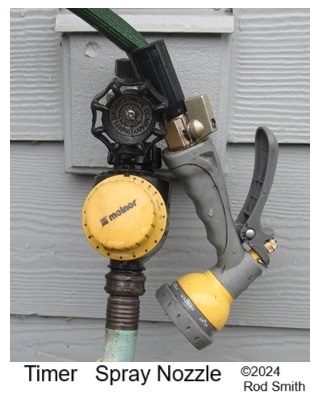
Several simple methods can be used to conserve water. A hose shut off on the end of a hose can save quite a bit of water. A watering wand will put water on the soil, not on leaves where it might encourage diseases. A water timer will automatically shut off hose end sprinklers. Battery powered water timers can turn the water on and off automatically.
A well designed irrigation system can end up saving water if it applies the water uniformly in the right amount. Water should be applied evenly and slowly enough that water soaks in instead of running off. The timer will need to be adjusted through the season as average temperatures rise and fall. Water sensors can be added to irrigation controllers to automatically adjust watering. Rainfall sensors shut off the irrigation until rainwater has evaporated from the rain collector. Soil moisture sensors are even more accurate. With these sensors, irrigation controllers are set to run everyday, but the irrigation is skipped until the soil actually needs water.
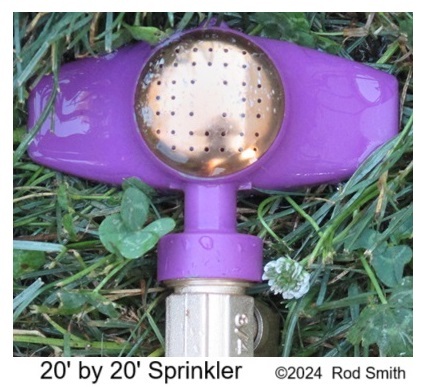
Run sprinklers at sunrise when the air is cool and there is less wind. Spread tuna cans around the yard to see how much water is being applied. Adjust or replace sprinkler heads so water is applied evenly. Never apply more than one inch of water at a time to trees and shrubs, or more than a half-inch on lawns and annuals.
Drip irrigation is the most efficient way to water. It places water directly onto the soil so it does not evaporate into the air. It can apply different amounts of water to different areas according to the number of emitters. Also, it does not waste water on areas where only weeds grow. Drip irrigation systems are easy to design and install. Any one that is handy at all can set up one. The drip system can be connected to a hose bib, or underground sprinkler systems can be converted to drip. Normally the half inch drip line is snaked through the landscape and emitters are inserted directly into the half inch drip line, or connected by a short length of quarter inch line. The drip lines can be buried but the emitters should be visible so they can be checked to see that they are not clogged.
Another way to save water is to capture rainfall and store it for later use. A good way to do this is to use a rain barrel to catch the water that falls on the roof. I cut one of the downspouts and used a section of flexible downspout to direct the water into my rain barrel. We use it exclusively for our house plants. Tap water is higher in chlorine content than is good for plants.
Rainfall can also be directed into a pond that is not waterproof on the sides. The water can soak into the surrounding soil to provide water for plants that need or tolerate wet soil.
Mulch
Covering
soil with mulch conserves water four ways. Mulch prevents the soil surface from being compacted by rainfall. Raindrops can pack the soil surface into a hard crust that does not absorb water. Mulch absorbs water and holds it until it can soak in instead of running off. Mulch keeps soil cooler so water does not evaporate as fast. Bare soil in full sun can heat up to 120 degrees, which can kill roots. Mulch reduces weeds, which can use quite a bit of water. Two or three inches of mulch is very effective, but do not cover lower branches or pile mulch more than an inch deep around stems, because diseases might develop.
Bark dust, compost, leaves, even newspaper can be used as mulch. But, decorative rock might increase water use because it transmits heat to the soil and reflects heat onto the plants. Black plastic is not good mulch because it does not let air or water soak in. Landscape fabric is better because it allows both water and air to move into the soil. Landscape fabric will also prevent perennial weeds from pushing up from the soil. However, it does not prevent weed seedlings from growing roots down through the fabric. Also, it interferes with earthworms which provide nutrients and aeration.
Mulching is also an effective way to conserve water in vegetable gardens. Newly planted seeds can be watered, then covered with damp newspaper. They will not need to be watered again until the seedlings emerge. Just be sure to remove the paper immediately when seedlings emerge so they do not overheat. Mulch also prevents a crust from forming on the surface of the soil, which hinders seedling emergence. Plants planted close together act like a mulch by shading the soil and reducing weeds.
Summary
Water Wise Gardening will lower your water bill as well as increase the growth and yields of fruits and vegetables, and improve the appearance of your landscape. It just makes good sense.
WARNING!! If you click on a link and a blank screen opens, then connects to a strange website, especially if you see a robot, CLOSE THE NEW WINDOW IMMEDIATELY!! The links will work correctly after the first time.
 Northwest has an abundance of rain during the winter, but summers are usually dry when plants need the most water. Portland averages five to seven inches of rain per month in the winter, but less than one inch in July and August. Daily water usage almost doubles during the summer months. The largest part of that summer bulge goes to water lawns and landscapes.
 Lawns require about an inch of water each week when temperatures stay below 80 degrees, or 1.5 inches above 80 degrees. Applying a half inch of water two or three times a week is much better than applying a small amount every day. Shallow watering encourages tree roots to grow on the surface while deep watering encourages a deeper root system which can draw water from a larger soil volume. For more information on lawns, see Lawn Care.
 plants which need less water usually fall into two groups: plants from arid climates and plants from Mediterranean climates which have dry summers. Arid plants need less water year round, and include cactus, succulents, junipers, pines and some grasses. Dry summer plants grow and flower in the fall, winter and spring and need little water during the summer. These include fall and spring flowering bulbs, Mediterranean heather and native plants, such as Oregon grape and flowering currant. Lydia Broom is a low growing shrub that flowers in the spring. It loses its leaves in the summer but the stems are green so it continues to look good.
 grouping plants according to water needs, it is possible to use the minimum amount of water. Much water is wasted when a plant that needs a lot of water is planted in with plants that do not need much water. Providing enough water for some high water need plants might kill some surrounding low water plants from too much water. Echinacea, lavender, heather, Japanese maples and native dogwoods are especially sensitive to over watering. If medium to high water need plants are included in a landscape, they should be grouped into areas where they can be watered separately. This website includes descriptions of about 900 trees, shrubs, vines, perennials and Oregon natives. Their water needs are rated Low, Medium or High. There is also a cross reference to look up plants by common names to find the scientific name.
 Sand should be concrete sand, not river sand, because concrete sand has sharp edges which hold the sand grains farther apart. Pumice is even better, because it has air pockets which can hold moisture and nutrients. Profile Soil Conditioner is like a manufactured pumice. Potting soil which contains sand or pumice is a good soil amendment if a small amount is needed. Large amounts can be purchased by the truckload from landscape supply yards. Amendments should be dug or tilled into the top foot of soil. For more information on soil, see
  depending on the soil, the weather and the number and size of plants. A screwdriver with a six inch long shaft is a good tool to check soil moisture on lawns, because it will indicate soil moisture deeper in the root zone. Check the soil a few days after watering. If it can easily be pushed all the way in to the handle, then the soil is probably wetter than it needs to be. If it takes fair amount of pressure to push it in most of the way, that is probably the right amount of soil moisture. If it can only be pushed in one inch, then the soil needs more water. A plant water meter is an even more accurate way to tell when lawns, trees and shrubs need watering again because it can measure soil moisture at different depths.
 soil with mulch conserves water four ways. Mulch prevents the soil surface from being compacted by rainfall. Raindrops can pack the soil surface into a hard crust that does not absorb water. Mulch absorbs water and holds it until it can soak in instead of running off. Mulch keeps soil cooler so water does not evaporate as fast. Bare soil in full sun can heat up to 120 degrees, which can kill roots. Mulch reduces weeds, which can use quite a bit of water. Two or three inches of mulch is very effective, but do not cover lower branches or pile mulch more than an inch deep around stems, because diseases might develop.