A lush, green lawn really sets off a house and is usually the center of the landscape. While lawns do require weekly maintenance, it is simple and fairly easy. Lawn maintenance can be even easier if some thought and effort is put into establishing the lawn.
Choosing a grass
A beautiful
lawn begins with choosing a type of grass that is suitable for the climate. Many types and varieties of grasses are now available. The best choices for the northern half of the US are cool season grasses, which grow the most in the spring and fall. For the western valleys of the Pacific Northwest, the best choice is perennial ryegrass for full sun and a mixture of perennial ryegrass and fescue for part-shade. New varieties of these grasses have a fine texture and good green color.
Perennial ryegrass grows upright so it mows very evenly. It is also a tough grass that tolerates foot traffic. One drawback to perennial ryegrass is that it has to be watered enough to keep it green during the growing season. Otherwise, it thins out until the lawn is dense clumps with bare spots in between. Perennial ryegrass will not spread to fill in the bare spots like most other grasses so bare spots need to be reseeded. However, there are a few new varieties of perennial ryegrass which spread.
Fescue is much more shade tolerant and drought tolerant than ryegrass. It stays green with less water. If it does turn brown, it recovers and greens up rapidly when fall rains arrive. A lawn that will not be watered should be at least half fescue. Creeping and Chewing's Fescue grow lower. Rhizomatous Tall Fescue, RTF, is taller growing and is a big improvement over Kentucky 31 Tall Fescue, but it still has a coarser texture than the other fescues.
Kentucky bluegrass is better for the
area from the Midwest to New England and the higher elevations of the upper South. Buffalo grass is not as nice looking but it is requires much less water so it is good for the Great Plains. Bent grass was very popular fifty years ago but it takes much more water and fertilizer to keep it green. Also, it is susceptible to every known lawn disease. It is mainly used for golf courses because it tolerates low mowing.
For the South, warm season grasses are used, such as, Bermuda grass, Zoysiagrass, Centipede grass and St. Augustine grass. Each has it strengths and weaknesses. Since they can dormant in the winter, ryegrass or fescue are sometimes overseeded in the fall so the lawn will stay green all winter.
Another alternative to grass is dwarf pennyroyal, which is a low growing mint. It grows better in the shade than any grass. I used it in a small courtyard and it worked very well. It only needed mowing once a month and smelled wonderful. It tolerates foot traffic and also discourages fleas. Descriptions of dwarf pennyroyal and other low growing grass alternatives can be found at Stepables.com. They list more than 80 low mow or no mow groundcovers that can be used as grass substitutes. About half of them have low water needs. I have also heard of a lawn of wild garlic in arid central Oregon, which stays green all year without any watering. But, imagine the smell while mowing it.
An alternative to a conventional lawn is an Eco-Lawn. Most Eco-lawns are a mixture of grasses, clovers, and flowering plants, such as, English Daisies, Roman Chamomile, Sweet Alyssum and Yarrow. Eco-Lawn seed mixes are available in Portland, Oregon, from Pro Time Lawn Seed. They will stay green all summer with only one inch of water every two weeks. They can be mowed three to four inches high every two weeks in the spring and fall when they grow fastest, or left un-mowed in the summer. They do not need to be fertilized because the beneficial bacteria that live in clover roots can pull nitrogen out of the air. I have not fertilized my Eco-lawn since I planted it in 2019 and it is always a nice green. They are low maintenance lawns but not no maintenance. People who did not give them minimum maintenance ripped them out after a few years and planted conventional lawns.
Establishing a new lawn
New lawns can be planted by seed or sod. For seed, the soil must be at least 55 degrees for the seed to germinate quickly. This is from mid-April to mid-October in western Oregon. Sod can be laid from March to November. Soil preparation for a new lawn is the same. The biggest difference is cost. Sod costs around ten times as much per square foot as grass seed. However, sod is better if the ground slopes enough to cause erosion since newly planted lawns need to be watered every day that it does not rain.
If a lawn has good soil but weedy grass, it can be renovated and replanted without tilling the soil.
The steps are:
1. Spray the weedy grass with Roundup which no longer contains glyphosate, and wait seven days, or smother it with black plastic and wait a month.
2. Mow the grass an inch high.
3. Use a power rake, also called a thatcher, to loosen the old grass and soil, then rake off the old grass.
4. Spread starter fertilizer and also lime if needed.
5. Spread grass seed evenly over the area.
6. Rake it in with a spring tooth rake or leaf rake.
7. Spread a thin layer of mulch over bare patches.
8. Water every day for three weeks, just enough to keep the soil moist.
If sod will be laid or the soil is poor or has high and low spots or needs to be re-graded, then it is better to till the soil and re-grade. See the chapter on Improving Soil for more information on poor soil. The first two steps are the same, but instead of using a power rake, spread lime and soil amendments, then rototill or spade as deep as possible, level the soil and roll it with a water filled roller and level again. Then continue with the grass seed fertilizer.
For seed,
spread the seed and rake it in lightly with a leaf rake. Then cover the seed with peat moss, compost, straw mulch or grass clippings. Peat moss is best because it changes color when it gets dry so it is obvious that it needs to be watered right away. Keep the soil moist for three weeks.
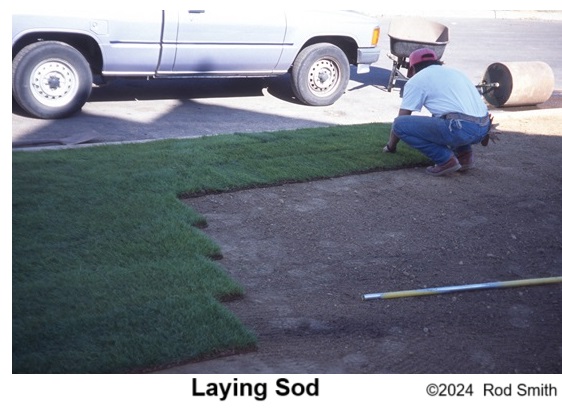
For sod, if the weather is sunny and hot, spray the soil with water to make it cool and moist before laying sod on it. Lay sod beginning with the longest straight line. Walk on the sod, not the soil, to avoid leaving depressions in the soil. Roll out the sod in the same directions so the beveled ends overlap. Pull the sides of the sod tight together and stagger the cross seams. When the sod is all laid and the edges trimmed, empty half of the water out of the water roller and go over the sod diagonally so the sod is pressed tight to the soil. Keep the sod constantly moist for two weeks until the sod is rooted into the soil.
Mowing
A new lawn should be mowed as soon as it reaches regular mowing height. The mower should be sharp because a dull blade might rip young seedlings out of the soil. Then regular mowing, usually weekly, during the growing season is the main task in maintaining a lawn. If the wheel tracks are still visible from the last mowing, then it is a good idea to vary the mowing pattern. I mow a clockwise spiral one week, then north-south the next week, then a counterclockwise spiral, then east-west. This prevents ruts from running the mower wheels in the same track each time. For riding mowers, I mow a different width on the second round, either one-third, two-thirds or full width. This varies the wheel tracks for the rest of the yard.
Mowing height is measured from the mower blade to the ground with the mower sitting on a flat surface. Mowing height for most grasses is 2 inches. For the summer, a mowing height of 3 to 4 inches will reduce water and fertilizer needs. Mowing at 1.5-2 inches during the rainy season reduces disease problems. Grass should be mowed as soon as it reaches one and a half times mowing height so only one third of the grass height is mowed off. If grass is allowed to get tall, then cut short, the soft, lush base of the grass will be exposed to hot sun and it will burn and turn brown. If the lawn gets too tall, set the mowing height higher, then, a few days later, mow the lawn again at the regular height. This is especially important during hot weather when the grass grows tall while people are on vacation.
I recommend buying a mower that can either mulch or bag the clippings. Grasscycling, that is, mulching the clippings back into the lawn, builds up the soil and requires less fertilizer. However, if the grass is tall or wet, the clippings might pile up and smother the grass. The grass clippings should be bagged if they start to pile up. Also, it is better to bag the clippings before a party if kids or guests might track grass clippings into the house.
Edging
Edging the lawn along sidewalks and driveways is optional but it gives the lawn a professionally manicured look. A straight, sharp edge looks professional but a 3-inch wide trench looks amateurish and might cause a sprained ankle. An electric or gasoline powered edger with a metal blade gives the best looking results. String trimmers also can be used for edging, but they require more skill.
Watering
Most grasses in most of the country need the equivalent of an inch of rainfall each week. More is needed during hot weather or in arid climates. If the grass has a dull appearance or it fails to stand back up after being stepped on, it is dry and needs watering immediately.
Both clay and sandy soils usually need a half-inch of water twice a week or three times a week if high temperatures are above 80 degrees. If the soil is loose and has lots of organic matter to hold water, an inch could be applied once a week. Watering every day prevents the grass from growing a deep root system and also causes tree roots to grow on the surface of the soil.
A handy way to measure how much water is applied is to scatter some tuna or pet food cans in different parts of the lawn. Whether hose end sprinklers or underground sprinklers are used, water should be applied evenly and slow enough that it soaks in and does not run off. The best time to water is around sunrise when the air is cool so less water evaporates before it hits the ground.
Fertilizing
Fertilizing a lawn regularly will give it healthy green color as well as help prevent disease and weed problems. If a lawn is well fed and growing rapidly, disease spots on the grass blades are mowed off before they become visible. A thick lawn will prevent weeds from getting started.
Lawns need mainly nitrogen, phosphorus and potassium or NPK. The numbers on every fertilizer bag are the percentages of N P and K found in the bag. Different lawn grasses need different amounts of nitrogen with bent grass and Improved Bermudagrass needing the most and fescue and centipede grass needing the least. A general recommendation that will do well with most grasses is 0.75 pounds of actual nitrogen per 1000 square feet every 6 weeks during the growing season. Divide 0.75 by the decimal form of the percentage of nitrogen to find how many pounds of fertilizer to apply each time. For example, a 15-5-10 would require 0.75 / 0.15 which equals 5 pounds of fertilizer per 1000 square feet every six weeks. A different approach for cool season grasses is to fertilize once in early spring and again in late summer. In that case, divide 1.50 by the decimal form of the percentage of nitrogen. This approach requires a slow release, non-burning fertilizer. One containing blood meal as the nitrogen source is the best choice.
Regarding which fertilizer to use, a turf research project at Oregon State University, comparing many different lawn fertilizers and ingredients, determined that every one tested worked equally well after one month. The only difference was that blood meal was still working after three months. Slow release fertilizers with a plastic coating on each pellet also last longer. Ammonium sulfate releases so quickly that it can burn lawns if 20% more than the recommended amount is applied.
Every
lawn that has been fertilized for years already has plenty of phosphorus in the soil so no more needs to be applied to an established lawn. The fertilizer that is already there can be used more efficiently if mycorrhizae are present in the soil. These are beneficial fungi
which are much more effective than plant roots at extracting nutrients from soil. Dr. Earth brand of fertilizers also contain mycorrhizae but they have a short shelf life. Better quality mycorrhizae can be ordered online and has a shelf life of about one year.l Usually there is already mycorrhizae in the soil unless it has been disturbed or excessive pesticides have been applied.
If grass
clippings are mulched back into the lawn, fertilizer amounts can be reduced by at least 20%.
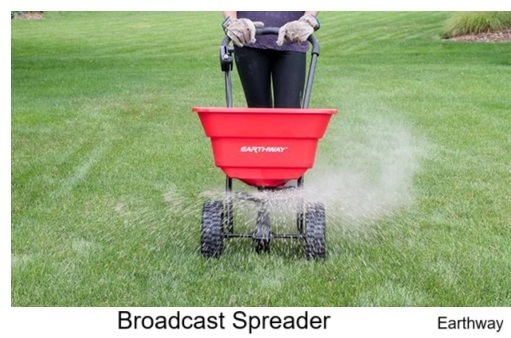
Fertilizer spreaders can be as simple as a hand crank Whirlybird or a wheel-driven spreader. Wheel-driven drop spreaders are the most accurate but the wheel tracks have to be overlapped just the right amount to avoid gaps or double applications. Wheel-driven broadcast spreaders usually give the most uniform results. The fertilizer tapers off at the edges so there is not a sharp line if the spreader is not overlapped by the right amount. Broadcast spreaders should throw the
fertilizer about as far as the last wheel track to get an even application.
Insect Control
Lawns in the Northwest are occasionally attacked by chinch bugs and grubs but the most damage is done by crane flies and billbugs. Damage is much worse in the last few years because two new insects have moved into the Portland area: common crane flies and billbugs.
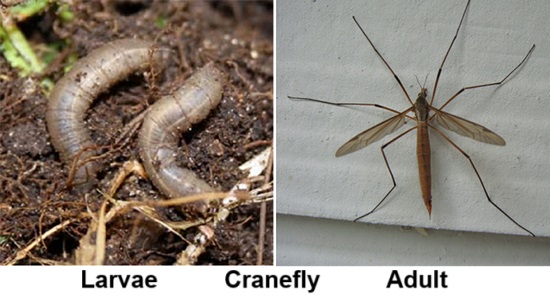
Common crane flies resemble European crane flies, which have been in the area since the 1980's. Both look like giant mosquitoes and both have larvae that feed on grass roots. Damaged grass can be pulled right out of the ground because there are no roots. The difference is that common crane flies have two generations each year. European crane fly larvae stop feeding in June, but the second generation of common crane fly larvae feed in July and August when lawns are the most stressed. Lawns can tolerate up to thirty European crane fly larvae per square foot without causing any visible damage, but I saw lawn damage with only twelve to fifteen common crane fly larvae per square foot in August.
The
surest way to tell if common crane flies are present is to watch for the adults. Both kinds of adult crane flies are present in late summer, but only common crane fly adults are present in the spring. Keeping the soil on the dry side in the fall reduces the survival rate of crane fly larvae, so cut watering way back after Labor Day.
Billbugs are not as widespread as crane flies, but a few will cause considerable damage. Six or eight larvae per square foot are enough to kill the grass. Billbugs have been a problem in northeast Oregon for years, but they were first found in Tualatin in 2012. In 2013, I found them, or heard reports of them, in Wilsonville, Newberg, Hillsboro, Beaverton, and northeast Portland. Young larvae feed inside grass roots. Older larvae feed on the crowns of grass. The grass turns brown and collapses so it lies flatter to the ground. Grass can be peeled off to reveal bare soil. Sometimes, larvae are visible on the surface of the bare soil, but they are usually a half inch deep in the soil. The oldest larvae are a 3/8 inch long white grub with a brown head. Adults are a weevil with a long, round snout. Fortunately, most varieties of fescue and ryegrass are high in endophytic fungi which kill billbugs. They are mainly a problem for bentgrass lawns.
The easiest way to check for soil insects is to dig up a plug of lawn on the edge of a dead spot, put it in a plastic bag and see what crawls out of the soil. A quicker way is to pull apart the plug of lawn and look for insects. Almost all lawn insects, except billbugs, can successfully be controlled by applying beneficial nematodes, which are microscopic worms which prey on many soil insects. Beneficial nematodes are effective at killing soil insects without affecting earthworms or mammals. Bifenthrin, cyfluthrin and imidicloprid are effective chemical controls for most lawn insects, including billbugs.
Disease Control
The three most common lawn diseases in the Pacific Northwest are Leaf Spot, Rust and Red Thread. Leaf Spot produces purplish spots with straw-colored centers on the grass blades. Rust is orange powder on the blades. Red Thread has tiny red filaments that grow across the lawn. Cultural controls include: regular, balanced fertilizing and watering to keep the grass growing strong, although excessive fertilizer in the fall and winter promote leaf spot; a mowing height of 1.5-2 inches, which cuts off the diseased spots before they become noticeable; Red Thread can be spread by the mower, so mow diseased areas last, then thoroughly clean the mower. If cultural controls are not sufficient, then Daconil, Eagle, Heritage, Mancozeb or Spotrete F fungicides will control all three diseases.
Weed Control
Weeds are either broadleaf, such as dandelions and thistles, or grassy, such as crabgrass and annual bluegrass. A complete list of common lawn weeds with pictures and a key to identify them is at http://www.ipm.ucdavis.edu/TOOLS/TURF/PESTS/weedkey.html. Broadleaf
weeds are easiest to control since many lawn weed killers will kill broadleaf weeds without harming grass. The active ingredients in most broadleaf weed killers are 2,4-D and Dicamba. Weed and feed fertilizers have to be applied evenly over the entire lawn, even where there are no weeds. I prefer to use a plain fertilizer, then spot spray liquid weed killer only on the weeds.
Grassy weeds are harder to control since most grass killers will kill lawn grasses as well as weedy grasses. Herbicides which contain Sulfentrazone are effective at killing crabgrass, yellow nutsedge, clover and dandelions, and is safe to use on ryegrass and most fescues, but not bentgrass or some
other grasses. A grassy weed preventer, such as Halts or Team, can be applied in the spring when the first dandelion blooms to prevent crabgrass, and around Labor Day to prevent annual bluegrass. Coarse perennial grasses which grow taller than the lawn grasses can be controlled by using a paint brush to apply Roundup to the taller tips a few days after mowing.
The best
weed control is a thick healthy lawn that crowds out weeds. Weeds are a sign that the lawn is stressed, usually by poor soil, lack of regular watering, lack of fertilizer or mowing too short. The top half of this picture is my Eco-Lawn. The bottom half is my neighbor's lawn. There are only a few dandelions in my lawn while they are thick in my neighbor's yard. The difference is that my yard gets nitrogen fertilizer from the bacteria in the clover roots and I mow four inches tall while my neighbor mows two inches tall. Low mowing allows more sunlight to reach the soil which encourages weed seeds to grow, but a higher mowing height causes the soil to be in deeper shade, which discourages weed seed growth.
Another common weed is moss. It grows anywhere the soil is constantly moist, even in full sun but especially especially where there is shade. Moss killer can be applied in early spring before moss smothers the grass. Almost all moss killers for lawns contain iron sulfate. It will stain concrete so sidewalks, driveways and patios should be blown or hosed off immediately after moss killer is applied.
Aerating
Soils that get walked on or trampled will pack down until air cannot penetrate into the soil to keep the roots healthy. If a lawn has patches where grass will not grow in spite of fertilizing and watering, it needs to be aerated. An aerator punches holes in the lawn every few inches to allow air and water to penetrate into the soil faster and deeper. The easiest and best way to deal with the cores that are left on the surface is to mow over them and scatter the soil onto the lawn surface. This fresh soil brings up microbes which help break down thatch.
The frequency of aerating depends on the soil and the amount of traffic on the lawn. Athletic fields are aerated every few months. A yard on clay soil with active kids might need aerating every year. On the other hand, a yard with rich soil and lots of earthworms
might never need aerating.
Thatching
Thatch is
a layer of dead stems and roots that can build up on the surface of the soil. If you dig into the lawn with your finger, it is fairly easy to tell the difference between the soft, light thatch and the hard, heavy soil. A quarter inch thick layer of thatch is of no concern and may be beneficial. If thatch is an inch thick, disease problems are almost sure to occur. Also, a thick layer of thatch will make a lawn require more water and fertilizer to keep the lawn green.
There are several products available to reduce thatch. They contain microbes that will break down thatch quicker. If the thatch is an inch thick, then it is better to use a thatcher, also called a power rake, to quickly remove thatch before diseases develop. Before using a thatcher, mow the grass an inch tall to reduce the damage to the grass. Set the depth on the thatcher so the teeth just reach the mineral soil. Then run the thatcher over the lawn twice, going east-west one time and north-south the other. The loosened thatch then needs to be raked up and hauled away. Do not bother adding it to your compost pile since it is tough roots and stems which are very slow to break down. Send it to a large yard debris composting site.
Thatching usually leaves bare patches so it is a good idea to spread starter fertilizer and grass seed after thatching so the bare patches fill in before weeds get started. Therefore, thatching should be done from mid-April to mid-October.
The frequency of thatching depends on the type of grass. Bentgrass, Kentucky bluegrass and creeping fescue might need to be thatched every year or two. Perennial ryegrass and tall fescue might never need to be thatched.
Choosing the right grass is the most important step in keeping a lawn attractive with minimum labor and expense.
WARNING!! If you click on a link and a blank screen opens, then connects to a strange website, especially if you see a robot, CLOSE THE NEW WINDOW IMMEDIATELY!! The links will work correctly after the first time.
 lawn begins with choosing a type of grass that is suitable for the climate. Many types and varieties of grasses are now available. The best choices for the northern half of the US are cool season grasses, which grow the most in the spring and fall. For the western valleys of the Pacific Northwest, the best choice is perennial ryegrass for full sun and a mixture of perennial ryegrass and fescue for part-shade. New varieties of these grasses have a fine texture and good green color.
 area from the Midwest to New England and the higher elevations of the upper South. Buffalo grass is not as nice looking but it is requires much less water so it is good for the Great Plains. Bent grass was very popular fifty years ago but it takes much more water and fertilizer to keep it green. Also, it is susceptible to every known lawn disease. It is mainly used for golf courses because it tolerates low mowing.
 The steps are:
 spread the seed and rake it in lightly with a leaf rake. Then cover the seed with peat moss, compost, straw mulch or grass clippings. Peat moss is best because it changes color when it gets dry so it is obvious that it needs to be watered right away. Keep the soil moist for three weeks.
 lawn that has been fertilized for years already has plenty of phosphorus in the soil so no more needs to be applied to an established lawn. The fertilizer that is already there can be used more efficiently if mycorrhizae are present in the soil. These are beneficial fungi
which are much more effective than plant roots at extracting nutrients from soil. Dr. Earth brand of fertilizers also contain mycorrhizae but they have a short shelf life. Better quality mycorrhizae can be ordered online and has a shelf life of about one year.l Usually there is already mycorrhizae in the soil unless it has been disturbed or excessive pesticides have been applied.
lawn that has been fertilized for years already has plenty of phosphorus in the soil so no more needs to be applied to an established lawn. The fertilizer that is already there can be used more efficiently if mycorrhizae are present in the soil. These are beneficial fungi
which are much more effective than plant roots at extracting nutrients from soil. Dr. Earth brand of fertilizers also contain mycorrhizae but they have a short shelf life. Better quality mycorrhizae can be ordered online and has a shelf life of about one year.l Usually there is already mycorrhizae in the soil unless it has been disturbed or excessive pesticides have been applied.
 surest way to tell if common crane flies are present is to watch for the adults. Both kinds of adult crane flies are present in late summer, but only common crane fly adults are present in the spring. Keeping the soil on the dry side in the fall reduces the survival rate of crane fly larvae, so cut watering way back after Labor Day.
 weed control is a thick healthy lawn that crowds out weeds. Weeds are a sign that the lawn is stressed, usually by poor soil, lack of regular watering, lack of fertilizer or mowing too short. The top half of this picture is my Eco-Lawn. The bottom half is my neighbor's lawn. There are only a few dandelions in my lawn while they are thick in my neighbor's yard. The difference is that my yard gets nitrogen fertilizer from the bacteria in the clover roots and I mow four inches tall while my neighbor mows two inches tall. Low mowing allows more sunlight to reach the soil which encourages weed seeds to grow, but a higher mowing height causes the soil to be in deeper shade, which discourages weed seed growth.
 a layer of dead stems and roots that can build up on the surface of the soil. If you dig into the lawn with your finger, it is fairly easy to tell the difference between the soft, light thatch and the hard, heavy soil. A quarter inch thick layer of thatch is of no concern and may be beneficial. If thatch is an inch thick, disease problems are almost sure to occur. Also, a thick layer of thatch will make a lawn require more water and fertilizer to keep the lawn green.