House plants bring color and life inside the house. Many have colorful leaves and flowers in interesting shapes. They especially add life and
interest when the days are dark and dreary outside. Here are some tips to help house plants grow better.
Put plants in places where they will get the right amount of light.
Light is the most important factor in making house plants grow well. House plants are listed in the following chart according to the minimum
amount of light they need. No plants will tolerate dim light for very long. Low light plants will tolerate low reading level light.
Moderate light plants will tolerate good reading level light. Bright light plants do best in a north window or near a sunny window but out of
direct sunlight. Filtered sun plants do best in a sunny window that is filtered by curtains or trees outside. Full sun plants need at least four
hours of direct sunshine each day. Some plants will tolerate a large range of light levels.
A light meter can be used to get an accurate measure of the amount of light in different parts of the house. They usually come with a list of
plants and the amount of light each plant needs.
East, south and west windows are all sunny, but each will get different amounts of light according to the season and trees that might shade them.
It may be necessary to move a plant to different windows to find the right amount of light. A few plants need more or less light when they are flowering.
Light can also be provided artificially with lights. LED lights are brighter and whiter than fluorescent lights. Special red and blue LED lights
are even better.
 Water plants according to their individual needs. Some plants need to have soil that is consistently moist. Other plants will die from root rot
unless the soil dries out between waterings. Also, African violets do not like to have the crown get wet, so use a watering can with a small spout so
the pot is not flooded. The following list of house plants indicates how much watering each prefers. Here are tips that work for all plants.
Water plants according to their individual needs. Some plants need to have soil that is consistently moist. Other plants will die from root rot
unless the soil dries out between waterings. Also, African violets do not like to have the crown get wet, so use a watering can with a small spout so
the pot is not flooded. The following list of house plants indicates how much watering each prefers. Here are tips that work for all plants.
When you water, give plants enough water each time so some drains out of the pot. This insures that all of the soil is wet. However,
some soil will shrink as it dries and pull away from the pot so the water drains out of the pot immediately without wetting the soil. If this
happens, place the pot in a sink and let a thin stream of water run until the soil is thoroughly wet. Or, give the plant several small waterings
until the soil swells and is thoroughly wet.
Do not let plants sit in a saucer of water. Watering will flush excess salt out of the soil, but the salt will be pulled back into the
soil unless the saucer is emptied. Excess salt causes salt burn which is a browning of the tips and edges of the leaves. Also, the soil may
stay wet too long if the pot is sitting in water. For plants which need high humidity, such as gardenia, fill the saucer with rocks to keep
the pot above the water level.
Let the plant tell you when to water again. Frequency of watering will change according to changing growth rates, light, temperatures
and air movement. A few plants like to be consistently moist so they do not mind being watered every day or two, but most plants do best if
the top one inch of soil is allowed to dry out between waterings. A few plants, such as figs, do better if the top two inches of soil dry out
before watering. If the soil is wet all of the time, many plants, especially figs, lose lots of their leaves and might develop root rot. Also,
fungus gnats are kept under control by letting the soil dry out. If a house plant takes more than two weeks to dry out, try planting some
additional plants in the pot so it needs watering about once a week.
Here are four ways to tell when the soil is dry enough to water. Lift the pot to see how heavy it is. Look at the drainage hole to see if the
soil is dry. Push a finger into the soil to check for moisture. Push a water meter into the soil to check the moisture level. The water meter
is the best method. It should come with a list of plants and how dry each likes to be before watering. Be sure to push the tip of the water
meter to a point halfway between the top and bottom of the soil to get an accurate measurement.
 Watering is made much simpler if the pot is the right size and shape for the plant. Low wide pots stay moist longer. Tall, narrow
pots drain better and dry out faster so they are better for plants that need to dry out between waterings. Also, glazed pots and plastic
pots stay moist longer because water will evaporate from the sides of clay pots. Choose a pot the right size for the size of the plant so
the plant needs to be watered about once a week. A moisture holding material, such as polyacrylamide gel, can be added to the soil. It soaks
up the excess water, then releases it again as the soil dries out. The moisture holding material should be mixed into the bottom half of the
pot so it does not migrate to the top of the soil as a slimy mess.
Watering is made much simpler if the pot is the right size and shape for the plant. Low wide pots stay moist longer. Tall, narrow
pots drain better and dry out faster so they are better for plants that need to dry out between waterings. Also, glazed pots and plastic
pots stay moist longer because water will evaporate from the sides of clay pots. Choose a pot the right size for the size of the plant so
the plant needs to be watered about once a week. A moisture holding material, such as polyacrylamide gel, can be added to the soil. It soaks
up the excess water, then releases it again as the soil dries out. The moisture holding material should be mixed into the bottom half of the
pot so it does not migrate to the top of the soil as a slimy mess.
Use a good quality potting soil suitable to the type of plant. Soil in pots does not drain as well as in the garden because the pot
interferes with
 drainage. Potting soils provide extra drainage by adding sand, perlite or pumice. Cactus and succulents need excellent drainage so they need
a special cactus soil. Orchids which naturally grow on trees need perfect drainage so they are grown in orchid bark. Potting soils which are
all organic provide good aeration and drainage when they are new, but as they age, the organic materials break down and the aeration and
drainage are reduced. Potting soils which contain sand or pumice maintain consistent aeration and drainage for a much longer time.
drainage. Potting soils provide extra drainage by adding sand, perlite or pumice. Cactus and succulents need excellent drainage so they need
a special cactus soil. Orchids which naturally grow on trees need perfect drainage so they are grown in orchid bark. Potting soils which are
all organic provide good aeration and drainage when they are new, but as they age, the organic materials break down and the aeration and
drainage are reduced. Potting soils which contain sand or pumice maintain consistent aeration and drainage for a much longer time.
Move plants to the next size larger pot only when the roots fill the present pot. Roots will come out of the drainage hole when the pot
is filled with roots. Repot into the next size larger pot or, perhaps, two sizes larger if a plant is fast growing. Too large of a pot will
cause the soil to stay wet for a long time which promotes root rot. When repotting, make one or two cuts down the side of the root ball to cut
circling roots. To limit the size of the plant and to keep it in the same pot, cut off the outer inch of soil and roots and replace it with
fresh potting soil. Begonia and Saxifraga stop blooming if they are root bound, but saintpaulia, aglaonema, hoya, impatiens, stephanotis and
strelitzia bloom better if slightly root bound. Most plants prefer to be repotted in the winter or early spring when not actively growing.
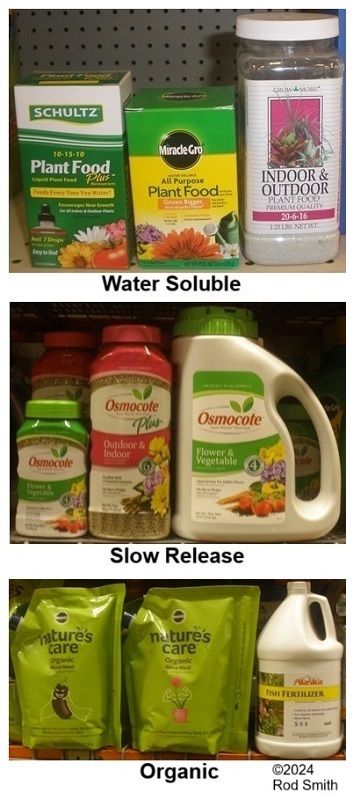
Fertilize regularly with a water soluble or a slow release fertilizer. Several companies make water soluble fertilizers that work well.
Osmocote makes several slow release formulas. Organic fertilizers are naturally slow release. Foliage plants need mainly nitrogen. Flowering
plants need nitrogen and a smaller amount of phosphorus. Bone meal is the best fertilizer for slow release phosphorus. I do not recommend
fertilizer sticks because they put too much fertilizer at one spot.
Check plants every week for insects and diseases. The most common disease is root rot from the soil being wet all of the time. The only
effective treatment is to let the soil dry out between waterings. Leaf spots, molds and mildews are less likely if the leaves are kept dry or
dry quickly. Spider mites are a problem on many plants, especially palms. Watch for off-color leaves and fine webbing. Scale and mealybugs are
also common. For small numbers, apply rubbing alcohol with a cotton swab, or a fine oil spray gives good control without poisonous fumes.
Keep house plants out of cold drafts. A patio door might look like a great place for house plants but cold drafts when the door is open
is hard on most plants. Also, hot dry air from heating vents can cause many leaves to quickly wilt. Heating vents could be closed or covered
with a baffle to direct hot air away from plants.
Low Light
Moderate Light
Bright Light
Filtered Sun
Full Sun
List of Common Names
House Plants listed by light requirements
Scientific name Moisture Description
Common name Light
Low Light
Aglaonema modestum Soak & Dry Colorful leaves. Tolerates low
Chinese Evergreen Low-Bright light and dry air.
Aspidistra elatior Soak & Dry Very tough plant survives heat and
Cast Iron Plant Low-Bright low light. Leaves grow from soil.
Cordyline fruticosa Moist Pink striped leaves. Tolerates low
Hawaiian Ti Plant Low-Sun light. Needs high humidity.
Dieffenbachia species Soak & dry Large, green and white leaves. Can
Dumbcane Low-Bright grow to ceiling. Poisonous sap.
Spathiphyllum species Moist Large green leaves with white
Peace Lily Low-Bright flower in fall.
Moderate Light
Adelomena wallisii Soak & dry Green and yellow leaves with
Camouflage Plant Mod-Bright irregular patterns.
Asplenium nidus Moist Large, arching fronds from a dark
Bird's Nest Fern Mod-Bright crown.
Begonia rex Soak & Dry Asymmetrical leaves with many
Rex Begonia Mod-Bright colors and spots.
Davallia fejeensis Moist Fuzzy rhizomes creep over and down
Rabbit's Foot Fern Mod-Bright pot. Needs high humidity.
Davallia trichomanoides Moist Very finely divided fronds with
Squirrel's Foot Fern Mod-Bright reddish fuzzy rhizomes.
Draceana fragrans Soak & dry Strap-like leaves, often striped.
Corn Plant Mod-Bright Can grow tall.
Draceana sanderiana Moist Strap-like leaves, often striped.
Lucky Bamboo Mod-Bright Can grow tall.
Draceana warneckii Soak & dry Strap-like leaves with white edges.
Warneck's Draceana Mod-Bright Sensitive to chlorine, fluoride.
Epipremnum aureum Soak & Dry Green leaves with golden variega-
Golden Pothos Mod-Bright tion. Climbing or trailing.
Gibasis pellucida Soak & dry Brown, pink and white leaves. Tiny
Tahitian Bridal Veil Mod-Bright white flowers. Trailing.
Homalomena wallisii Moist not wet Large, green and white mottled
Camouflage Plant Mod-Bright leaves. Toxic to people, pets.
Palms: Chamaedorea, Dypsis, Soak & dry Many sizes and frond shapes. Some
Howea, Ravenea Mod-Bright grow tall.
Platycerium bifurcatum Moist Forms large, branched fronds on a
Staghorn Fern Mod-Bright wall. Soak once a week.
Plerandra elegantissima Moist Finely divided leaves with serrated
False Aralia Mod-Bright edges. Woody stem for bonsai.
Polyscias balfouriana Soak & dry Round, scalloped leaves of green
Balfour Aralia Mod-Bright with white markings near edge.
Pteris cretica Moist Long, narrow leaflets. Some varie-
Brake Fern Mod-Bright gated or frilled.
Rhapis excelsa Soak & dry Dark green fan-shaped leaves. Slow
Lady Palm Mod-Bright growing to 6 feet tall.
Rhodospatha rojo Moist Deep green leaves flushed with
Red Rhodospatha Mod-Bright purple. Likes humidity.
Tolmiea menziesii Moist Plantlets sprout from leaves.
Piggyback Plant Mod-Bright
Bright Light
Achimines grandiflora Moist White, red, salmon, pink, yellow,
Orchid Pansy Bright blue or purple flowers in summer.
Achimines longifolia Moist White flowers with purplish veins
Hot Water Plant Bright in May to fall.
Alocasia zebrina Soak & dry Large dark leaves with light green
Elephant Ear Bright-Filt veins.
Aloe vera Soak & dry Leaves are thick curving spikes.
Burn Plant Bright-Sun Inner gel used for healing.
Ananas comosus Soak & dry Twist top off, expose 1" of stem,
Pineapple Bright-Filt dry a day, plant in sandy soil.
Anthurium andraeanum Moist Colorful, long lasting red, orange
Flamingo Flower Bright-Filt or white flowers.
Aphelandra squarrosa Moist White striped leaves. Yellow
Zebra Plant Bright flowers in fall. Mist.
Asparagus specjes Soak & dry Fine foliage. Fragrant white flower
Asparagus Fern Bright-Filt in May. Red berries in fall.
Beaucarnea recurvata Soak & dry Long, narrow leaves on a fat stem
Ponytail Palm Bright-Sun and bulbous root.
Bromeliad guzmania Soak & dry Red or orange new growth. Keep urns
Guzman Bromeliad Bright-Filt at least 1/4 full. Needs humidity.
Caladium species Soak & dry Large white or pink leaves with
Angel Wing Bright green veins.
Clivia miniata Soak & dry Strap-like leaves. Large orange and
Natal Lily Bright yellow flowers in spring.
Codiaeum variegatum Soak & dry Large oval leaves of various colors
Croton Bright-Filt on same plant. Needs humidity.
Cycas revoluta Soak & dry Stiff fern-like leaves. Very slow
Sago Palm Bright-Filt growing.
Cyclamen persicum Moist Heart shaped leaves. Butterfly
Persian Cyclamen Bright-Filt shaped flowers in winter.
Ficus benjamina Soak & dry Shiny leaves on drooping branches.
Weepng Fig Bright Moving causes leaves to drop.
Ficus elastica Soak & dry Upright leaves of reddish green or
Rubber Tree Bright green and white.
Ficus pumila Soak & dry Two inch leaves on creeping stems.
Creepng Fig Bright-Filt Moving causes leaves to drop.
Fittonia albivenis Moist Velvety green leaves with white,
Nerve Plant Bright pink or red veins.
Gynura aurantiaca Soak & dry Purple velvety covering on stems
Purple Velvet Plant Bright-Filt and leaves.
Haworthiopsis attenuata Soak & Dry Succulent. Rosettes of dark green
Zebra Haworthia Bright leaves with white, bumpy stripes.
Hippeastrum species Moist Large red, pink or white flowers.
Amaryllis Bright Allow to go dormant in summer.
Hoya carnosa Soak & Dry Vining plants with clusters of very
Wax Plant Bright-Filt fragrant waxy flowers.
Hypoestes phyllostachya Soak & Dry Unusual pink, white or red marks
Pink Polka Dot Bright-Filt on green leaves.
Impatiens walleriana Moist Pink, red, orange, purple and white
Busy-lizzy Bright-Filt flowers available.
Impatiens x hawkeri Moist Large pink, red, orange, lavender
New Guinea Impatiens Bright or purple flowers. Not hardy.
Kalanchoe blossfeldiana Soak & dry Scarlet, orange or yellow flowers.
Kalanchoe Bright-Filt
Mandevilla sanderi Moist Vining. Large pink to rose flowers
Mandevilla Bright with yellow throat spring-fall.
Maranta leuconeura Moist Curved red or white stripes on oval
Prayer Plant Bright green leaves.
Mimosa pudica Moist Finely divided leaflets immediately
Sensitive plant Bright fold up if touched.
Monstera deliciosa Soak & dry Large leaves are split as they
Swiss Cheese Plant Bright mature. Trunk needs support.
Nephrolepis exaltata Moist Arching fronds make a great hanging
Boston Fern Bright basket.
Orchids: Cattleya, Dendrobium Soak & dry Many sizes and frond shapes. Add
Cymbidium Bright humidity with pebbles and water.
Oxalis regnellii Soak & dry Green clover-shaped leaves. White
Shamrock Bright-Filt flowers in fall, winter, spring.
Oxalis triangularis Soak & dry Purple clover-shaped leaves. Tiny
Purple Shamrock Bright-Filt white flowers.
Peperomia species Soak & dry Many leaf shapes. Some upright,
Peperomia Bright some trailing.
Phalaenopsis species Moist Large, long lasting flowers resem-
Moth Orchid Bright-Filt ble moths. Use orchid soil.
Philodendron verrucosum Moist Light and dark green heart shaped
Heart Leaf Philodendron Bright leaves are maroon underneath.
Phyllotaenium lindenii Moist Large shield-shaped leaves with
Angel Wing Bright white center stripe and ribs.
Pilea cadierei Moist Green leaves have silver splotches.
Aluminum Plant Bright Likes high humidity.
Polyscias filicifolia Soak & dry Fine textured leaves. Can be
Fernleaf Aralia Bright-Filt trained as Bonsai.
Rhoeo discolor Soak & dry Leaves are green on top, purple on
Moses in the Cradle Bright bottom. Flowers are boat shaped.
Saintpaulia ionatha Moist Rosette of leaves with white or
African Violet Bright-Filt pink flowers. 11 hours of light.
Sansevieria trifasciata Soak & dry Lance shaped leaves with yellow
Snake Plant Bright-Filt margins and silver bands.
Saxifraga stolonifera Soak & dry Leaves are shaped like a geranium
Strawberry Saxifrage Bright and colored like a begonia.
Schefflera actinophylla Soak & dry Leaves have eight leaflets. Mist
Octopus Plant Bright daily to provide humidity.
Schefflera arboricola Soak & dry Eight leaflets on the leaf stalk
Octopus Plant Bright spread like an umbrella.
Schlumbergera x buckleyi Moist-dry Needs long nights and reduced water
Christmas Cactus Bright in late Sept. to form flowers.
Stephanotis floribunda Moist Vining plant with very fragrant
Madagascar Jasmine Bright-Filt white flowers in June.
Strobilanthes dyerianus Soak & Dry Leaves marbled with purple and blue
Persian Shield Bright-Filt with wine red underneath.
Tillandsia cyanea Soak & dry Purple flowers on deep pink, paddle
Pink Quill Bromeliad Bright shaped stalks. Keep water in top.
Tradescantia zebrina Soak & Dry Silver and purple stripes. Great
Wandering Dude Bright for hanging baskets.
Filtered Sun
Abutilon spp. Very moist Rapid growing. Red, orange, yellow,
Flowering Maple Filt-Sun purple or white flowers.
Acalypha hispida Moist Has long plumes of tiny red flowers
Chenille Plant Filt-Sun Needs regular pruning.
Acalypha wilkesiana Soak & dry Glossy leaves of red, copper, pink,
Jacob's Coat Filt-Sun gold and brown.
Acanthocereus tetragonus Dry Cluster of upright cactus stems can
Fairy Castle Cactus Filt-Sun rarely have large white flowers.
Araucaria heterophylla Moist Formal, tree-like growth habit.
Norfolk Island Pine Filt-Sun Can reach the ceiling.
Begonia bowerae Moist Heart shaped emerald green leaves
Eyelash Begonia Filtered with brown marks. White flowers.
Begonia species Moist Many sizes and colors of leaves.
Begonia Filtered Red, pink or white flowers.
Coffea arabica Soak & dry Shiny leaves with wavy edges. Needs
Arabian Coffee Tree Filt-Sun high humidity.
Crassula ovata Soak & dry Thick leaves and branches. Some
Jade Plant Filt-Sun with striped leaves.
Cuphea ignea Moist Tiny, tube-like red flowers attract
Cigar Flower Filt-Sun butterflies, hummingbirds.
Cyperus alternifolius Very moist Long green stems topped by a whorl
Umbrella Palm Filt-Sun of leaves. Grows in shallow water
Draceana marginata Soak & dry Long, narrow leaves, often striped.
Dragon Tree Filtered Can grow tall.
Echeveria species Soak & dry Rosette of thick leaves. Plantlets
Hen and Chicks Filt-Sun sprout all around. Sandy soil.
Euphorbia pulcherrima Soak & Dry Red, pink, white or marbled flowers
Poinsettia Filtered at Christmas time.
Fatshedera lizei Moist Hybrid of Japanese aralia and
Tree Ivy Filtered English ivy. Needs staking.
Gardenia jasminoides Very moist Very fragrant white flowers. Needs
Gardenia Filtered high humidity and cool nights.
Huernia zebrina Soak & Dry 5 pointed yellow flower with copper
Lifesaver Filt-Sun bands and dark red lifesaver rim.
Monstera adansonii Soak & dry Leaves have rounded holes in them.
Swiss Cheese Plant Filtered Climbing or trailing.
Philodendron x 'Ring of Fire' Moist Variegated leaves with greens, yel-
Ring of Fire Philodendron Filtered lows, oranges and reds.
Pilea involucrata 'Moon Valley Moist Uniquely textured leaves: green on
Moon Valley Friendship Plant Filtered surface and darker beneath.
Plectranthus verticillatus Moist Trailing plant with lush green
Swedish Ivy Filtered scalloped leaves. White flowers.
Ravenea rivularis Moist Tall growing. Keep soil moist but
Majesty Palm Filtered never soggy.
Strelitzia reginae Moist Exotic flowers of orange, blue and
Bird of Paradise Filt-Sun white all year.
Full Sun
Cactus: Aporocactus, Carnegiea Moist-dry Many sizes and colors. Moist when
Mammillaria, Opuntia Full Sun growing/flowering, then dry.
Capsicum annuum Moist Bright red peppers are edible, but
Ornamental Pepper Full Sun extremely hot.
Carissa macrocarpa Moist Fragrant white flowers produce
Natal Plum Full Sun edible red fruit.
Citrus species Soak & dry Fragrant white flowers and colorful
Citrus Full Sun fruit.
Cuphea llavea Moist Tiny, tube-like red flowers.
Bat-Faced Cuphea Full Sun
Echinocactus grusonii Soak & dry Yellow spines on fat, dark green
Golden Barrel Cactus Full Sun stem. Needs very well drained soil.
Euphorbia abyssinica Soak & dry Thick, dark green stem with short
Abyssinian Euphorbia Full Sun spines on ridges.
Lantana species Never wet Fragrant red, yellow or white
Lantana Full Sun flowers in summer.
Pachycereus pringlei Soak & dry Many spines on bluish trunk. The tall-
Mexican Cardon Full Sun est growing cactus up to 60 feet.
Pelargonium peltata Soak & dry Red, salmon, orange, pink and white
Geranium Full Sun flowers.
Solanum pseudocapsicum Moist Flowers and red fruit in the fall.
Christmas Cherry Full Sun Needs abundant light to flower.
Common Names Scientific Names Lights
African Violet Saintpaulia ionatha Bright
Alocasia Alocasia species Bright
Aluminum Plant Pilea cadierei Bright
Amaryllis Hippeastrum species Bright
Angel Wing Caladium species Bright
Angel Wing Phyllotaenium lindenii Bright
Arabian Coffee Tree Coffea arabica Filtered
Aralia, False Plerandra elegantissima Moderate
Aralia, Fernleaf Polyscias filicifolia Bright
Areca Palm, Bamboo Palm Dypsis lutescens Filtered
Army Homalomena Homalomena wallisii Moderate
Asparagus Fern Asparagus species Bright
Bamboo, Lucky Draceana sanderiana Moderate
Bat-faced Cuphea Cuphea llavea Filtered
Begonia Begonia species Filtered
Begonia, Eyelash Begonia bowerae Filtered
Begonia, Rex Begonia rex Moderate
Begonia, Strawberry Saxifraga stolonifera Bright
Bird of Paradise Strelitzia reginae Filtered
Bird's Nest Fern Asplenium nidus Moderate
Boat Orchid Cymbidium species Bright
Boston Fern Nephrolepis exaltata Bright
Brake Fern Pteris cretica Moderate
Bridal Veil, Taitian Gibasis pellucida Moderate
Bromeliad, Pink Quill Tillandsia cyanea Bright
Burn Plant Aloe vera Bright
Busy-lizzy Impatiens wallerana Bright
Butterfly Palm Dypsis lutescens Filtered
Cactus Cactus Full Sun
Cactus, Christmas Schlumbergera x buckleyi Bright
Cactus, Fairy Castle Acanthocereus tetragonus Full Sun
Camouflage Plant Homalomena wallisii Moderate
Cardon, Mexican Pachycereus pringlei Full Sun
Cast Iron Plant Aspidistra elatior Low
Chenille Plant Acalypha hispida Filtered
Cherry, Christmas Solanum pseudocapsicum Full Sun
Chinese Evergreen Aglaonema modestum Low
Christmas Cactus Schlumbergera x buckleyi Bright
Christmas Cherry Solanum pseudocapsicum Full Sun
Cigar Flower Cuphea ignea Filtered
Citrus Citrus species Full Sun
Coffee Tree, Arabian Coffea arabica Filtered
Common Jade Plant Crassula ovata Filtered
Corn Plant Draceana fragrans Moderate
Corsage Orhid Cattleya species Bright
Creepng Fig Ficus pumila Bright
Croton Codiaeum variegatum Bright
Cyclamen, Persian Cyclamen persicum Bright
Dallas Fern Nephrolepis exaltata Bright
Dendrobium Orchid Dendrobium species Bright
Dracaena Draceana species Moderate
Draceana, Warneck's Draceana warneckii Moderate
Dragon Tree Draceana marginata Moderate
Dude, Wandering Tradescantia zebrina Bright
Dumbcane Dieffenbachia species Low
Dwarf Umbrella Tree Schefflera arboricola Bright
Elephant Ear Alocasia zebrina Bright
Eyelash Begonia Begonia bowerae Filtered
Fairy Castle Cactus Acanthocereus tetragonus Full Sun
False Aralia Plerandra elegantissima Moderate
Fern, Asparagus Asparagus species Bright
Fern, Boston Nephrolepis exaltata Bright
Fern, Brake Pteris cretica Moderate
Fern, Dallas Nephrolepis exaltata Bright
Fern, Rabbit's Foot Davalia fejeensis Moderate
Fern, Squirrel's Davallia trichomanoides Moderate
Fern, Squirrel's Foot Davallia trichomanoides Moderate
Fern, Staghorn Platycerium bifurcatum Moderate
Fernleaf Aralia Polyscias filicifolia Bright
Fig, Creepng Ficus pumila Bright
Fig, Weepng Ficus benjamina Bright
Figs Ficus species Bright
Flamingo Flower Anthurium andraeanum Bright
Flamingo Flower Anthurium scherzeranum Filtered
Flowering Maple Abutilon species Filtered
Friendship Plant, Moon Vall. Pilea involucrata 'Moon Valley Filtered
Gardenia Gardenia jasminoides Filtered
Geranium Pelargonium peltata Full Sun
Golden Pothos Epipremnum aureum Moderate
Hawaiian Ti Plant Cordyline fruticosa Low
Haworthia, Zebra Haworthiopsis attenuata Bright
Heart Leaf Philodendron Philodendron verrucosum Bright
Hen and Chicks Echeveria species Filtered
Homalomena, Army Homalomena wallisii Moderate
Hot Water Plant Achimines longifolia Bright
Impatiens, New Guinea Impatiens x hawkeri Bright
Ivy, Swedish Plectranthus verticillatus Bright
Ivy, Tree Fatshedera lizei Filtered
Jacob's Coat Acalypha wilkesiana Filtered
Jade Plant, Common Crassula ovata Filtered
Jade Plant, Silver Crassula argentea Filtered
Jasmine, Madagascar Stephanotis floribunda Bright
Kaffir Lily Clivia miniata Bright
Kalanchoe Kalanchoe blossfeldiana Bright
Kentia Palm, Sentry Palm Howea fosteriana Bright
Lady Palm Rhapis excelsa Moderate
Lantana Lantana species Full Sun
Lifesaver Huernia zebrina Filtered
Lily, Kaffir Clivia miniata Bright
Lily, Peace Spathiphyllum species Low
Lucky Bamboo Draceana sanderiana Moderate
Madagascar Jasmine Stephanotis floribunda Bright
Majesty Palm Ravenea rivularis Moderate
Mammillaria, Opuntia Cactus: Aporocactus, Carnegiea Full Sun
Mandevilla Mandevilla sanderi Bright
Mexican Cardon Pachycereus pringlei Full Sun
Moon Valley Friendship Plant Pilea involucrata 'Moon Valley Filtered
Moses-in-the-Cradle Tradescantia spathacea Bright
Natal Lily Clivia miniata Bright
Natal Plum Carissa macrocarpa Full Sun
Nerve Plant Fittonia albivenis Bright
New Guinea Impatiens Impatiens x hawkeri Bright
Norfolk Island Pine Araucaria heterophylla Filtered
Octopus Plant Schefflera arboricola Bright
Octopus Plant Schefflera actinophylla Bright
Orchid Pansy Achimines grandiflora Bright
Orchid, Boat Cymbidium species Bright
Orchid, Corsage Cattleya species Bright
Orchid, Dendrobium Dendrobium species Bright
Ornamental Pepper Capsicum annuum Full Sun
Palm, Areca Dypsis lutescens Filtered
Palm, Bamboo Dypsis lutescens Filtered
Palm, Kentia Howea fosteriana Bright
Palm, Lady Rhapis excelsa Moderate
Palm, Majesty Ravenea rivularis Moderate
Palm, Neanthe Bella Chamaedorea elegans Bright
Palm, Parlor Chamaedorea elegans Bright
Palm, Ponytail Beaucarnea recurvata Bright
Palm, Sago Cycas revoluta Bright
Palm, Sentry Howea fosteriana Bright
Palm, Umbrella Cyperus alternifolius Filtered
Pansy, Orchid Achimines grandiflora Bright
Parlor Palm, Neanthe Bella Chamaedorea elegans Bright
Peace Lily Spathiphyllum species Low
Peperomia Peperomia species Bright
Pepper, Ornamental Capsicum annuum Full Sun
Pern, Bird's Nest Asplenium nidus Moderate
Persian Cyclamen Cyclamen persicum Bright
Persian Shield Strobilanthes dyerianus Bright
Philodendron, Heart Leaf Philodendron verrucosum Bright
Philodendron, Ring of Fire Philodendron x 'Ring of Fire' Filtered
Philodendron, Split Leaf Monstera deliciosa Bright
Piggyback Plant Tolmiea menziesii Moderate
Pine, Norfolk Island Araucaria heterophylla Filtered
Pineapple Ananas comosus Bright
Pink Polka Dot Hypoestes phyllostachya Bright
Pink Quill Bromeliad Tillandsia cyanea Bright
Plum, Natal Carissa macrocarpa Full Sun
Poinsettia Euphorbia pulcherrima Filtered
Ponytail Palm Beaucarnea recurvata Bright
Pothos, Golden Epipremnum aureum Moderate
Prayer Plant Maranta leuconeura Bright
Purple Shamrock Oxalis triangularis Bright
Purple Velvet Plant Gynura aurantiaca Bright
Rabbit's Foot Fern Davalia fejeensis Moderate
Red Rhodospatha Rhodospatha rojo Moderate
Rex Begonia Begonia rex Moderate
Rhodospatha, Red Rhodospatha rojo Moderate
Ring of Fire Philodendron Philodendron x 'Ring of Fire' Filtered
Rubber Tree Ficus elastica Bright
Sago Palm Cycas revoluta Bright
Schefflera Schefflera actinophylla Bright
Sensitive plant Mimosa pudica Bright
Shamrock Oxalis regnellii Bright
Shamrock, Purple Oxalis triangularis Bright
Shield, Persian Strobilanthes dyerianus Bright
Silver Jade Plant Crassula argentea Filtered
Snake Plant Sansevieria trifasciata Bright
Split Leaf Philodendron Monstera deliciosa Bright
Squirrel's Foot Fern Davallia trichomanoides Moderate
Staghorn Fern Platycerium bifurcatum Moderate
Stephanotis Stephanotis floribunda Bright
Strawberry Begonia Saxifraga stolonifera Bright
Swedish Ivy Plectranthus verticillatus Bright
Swiss Cheese Plant Monstera adonsonii Filtered
Taitian Bridal Veil Gibasis pellucida Moderate
Tree Ivy Fatshedera lizei Filtered
Umbrella Palm Cyperus alternifolius Filtered
Umbrella Plant Cyperus alternifolius Filtered
Umbrella Tree Schefflera actinophylla Bright
Velvet Plant, Purple Gynura aurantiaca Bright
Violet, African Saintpaulia ionatha Bright
Wandering Dude Tradescantia zebrina Bright
Warneck's Draceana Draceana warneckii Moderate
Water Plant, Hot Achimines longifolia Bright
Wax Plant Hoya carnosa Bright
Weepng Fig Ficus benjamina Bright
Zebra Haworthia Haworthiopsis attenuata Bright
Zebra Plant Aphelandra squarrosa Bright