 shaped and self-pollinating, while plums are round and most varieties need a pollinator.
Many fruit trees require at least two varieties for cross pollination in order to get a good crop of fruit, but these fruit trees will have a good crop by themselves: apricots, pie cherries, figs, nectarines, peaches, prunes Many fruit trees require at least two varieties for cross-pollination in order to get a good crop of fruit, but these fruit trees will have a good crop by themselves: apricots, pie cherries, figs, nectarines, peaches, prunes and persimmons.
Also these varieties will have a good crop by themselves, though they will often have more
fruit with a second variety for cross-pollination:
Apples: Braeburn, Cortland, Crispin, Gala, Golden Delicious, Granny Smith, Jon-a-Red, Pink Lady and Red Rome.
Sweet cherries: Early Burlat, Lapins, Sonata and Stella,
Pears: Baldwin, Keiffer, Moonglow, Red Bartlett, Starkcrimson and 20th Century,
Plums: Beauty, Green Gage, Methley and Santa Rosa.
If there is room for only one fruit tree, plant a self-pollinating fruit or a combination tree with two or more varieties grafted onto it. There are also combination trees that include apricots, cherries, nectarines and peaches on one tree.
The difference between plums and prunes is that prunes can be dried with the pit inside, while
plums will spoil if the pit is not removed before drying. Both can be eaten fresh or dried.
Also, prunes are egg
shaped and self-pollinating, while plums are round and most varieties need a pollinator.
Asian pears will often have fruit the first year. They are the easiest tree fruit to grow. Apples, European pears, figs and persimmons are also easy to grow. Apricots, nectarines, peaches, and cherries need more care because of disease problems. Apricots are the hardest to grow because they bloom early and a late frost will kill the flowers. Puget Gold blooms last. OSU Extension Services has a excellent guide at Managing Diseases and Insects in Home Orchards
The best fruit is always in the top of the tree because it gets the most sunlight and best air circulation. But a tall ladder is not very safe to climb. If the top of the tree is too tall to reach, the best fruit is wasted. The introduction of dwarfing rootstocks has made it much easier to harvest, prune and spray fruit trees.
Dwarf and Semi Dwarf rootstocks are available for many fruit trees. Plant the tree so the graft is at least two inches above ground level, because the tree will grow to full size if the trunk sends out roots above the graft. Very Dwarf rootstocks produce trees that will grow 5-6 feet tall: M27 for apples and Tabel for cherries. Dwarf rootstocks produce trees that will grow 8 to 10 feet tall: M9 for apples, Quince C for pears and Gisela 5 for cherries. Semi Dwarf rootstocks produce trees that will grow 10 to 12 feet tall: M26 for apples and Pixy for plums. Semi Vigorous rootstocks produce trees that will grow 12 to 15 feet tall: MM106 for apples, Colt for cherries, Quince A for pears and St Julien for plums. These heights are approximate because some varieties grow more vigorously than others. Also, pruning makes a big difference in size. Semi Dwarf trees are usually stronger and bear fruit sooner than Dwarf trees because dwarfing rootstocks keep trees smaller because the roots are weaker growing. Plus, M9 is brittle and the graft will break unless trees are staked or trained on a trellis.
The ideal shape that will produce and support the greatest number of fruit is a single trunk with spaced branches with a strong crotch which grow upward and outward. A strong crotch will have a ridge of bark which runs through the center of the crotch. A weak crotch has a line where the bark disappears into the crotch. The most productive branches grow at an angle between horizontal and forty-five degrees. Thirty degrees is ideal for apples and pears but cherries, peaches and nectarines should be more upright. Branches that grow straight up do not produce fruit and shade out the branches that do produce fruit. Branches which hang down will produce fruit but it will be smaller. This is because the concentration of growth hormones is affected by gravity.
The tree should be cone shaped so the upper branches do not shade out the lower branches. The top of the tree can be cut off just above a branch so the top branch can be reached by a ladder. The first five years are the most important for training a fruit tree so it develops a strong structure. After many years, branches becomes less productive. Sometimes a newer sprout should be allowed to develop for a couple of years, then remove the nearest old branch.
Ringing is
 a technique that can help young fruit trees start bearing more fruit at a younger age. In
late July or early August, a knife is used to cut through the bark to the wood all around the trunk
below the lowest branch. A second cut is made a sixteenth of an inch above or below the first cut. Then
the ring of bark is removed. This prevents sugars from flowing down through the bark to the roots, so
there is more food in the top of the tree to promote the production of more flower buds. The cut has to
be narrow enough that the ring will heal before growth stops in the fall. Ringing a tree the first two
years is enough to switch the tree from growth mode to fruiting mode.
a technique that can help young fruit trees start bearing more fruit at a younger age. In
late July or early August, a knife is used to cut through the bark to the wood all around the trunk
below the lowest branch. A second cut is made a sixteenth of an inch above or below the first cut. Then
the ring of bark is removed. This prevents sugars from flowing down through the bark to the roots, so
there is more food in the top of the tree to promote the production of more flower buds. The cut has to
be narrow enough that the ring will heal before growth stops in the fall. Ringing a tree the first two
years is enough to switch the tree from growth mode to fruiting mode.
Fruit trees have to be pruned differently, depending on whether they produce their flowers and fruit on old wood or new wood. At harvest time, look to see where the fruit is found. Notice if more fruit is produced on branches that grow fast or slow. Then adjust your pruning and fertilizing accordingly.
Apples, cherries, pears, and plums bear fruit on fruit spurs, which are short twigs on older wood. Spurs will die out if they are shaded too much. Upper and outer branches should be thinned to let light and air into the center of the tree so the fruit spurs will remain healthy. Pruning the longest twigs back to three to five leaves in mid-July to mid-August, when they are at least the thickness of a pencil, will encourage more fruit spurs to form.
Peaches, nectarines and apricots bear fruit on one year old wood. A few older branches can be removed each year to encourage more new growth.
Suckers and water sprouts grow rapidly straight up. They do not produce fruit, and they shade out the spreading branches that do produce fruit. They can be plucked off when they first appear in June much easier than cutting them off later. Or, they can be tied down so they grow outward and become productive branches.
Fruit trees can be pruned in the winter, spring, or summer. Winter pruning causes a tree to grow more vigorously. Spring pruning, after the fruit has set, keeps dwarf trees smaller and does not reduce the fruit crop as much. By late spring, it is obvious which branches are producing fruit and which are not, so productive branches can be saved. Cutting back vigorous apple and pear twigs to three to five leaves in mid-summer will encourage more fruit spurs.
Tree fruits will have the most flavor if they are allowed to ripen on the tree and eaten right away. But, they will store longer if they are picked before they are fully ripe. When ripe, the green background color will change to yellow. For red fruit, look at the bottom of the fruit to see the background color.
Another test for ripeness is to pinch the fruit to check for softness. Ripe fruit will be considerably softer than green fruit. A ripe peach or nectarine will dent easily with a fingertip. For apples and pears, a piece of skin is peeled off and a special pressure gauge is used to test for firmness.
European pears should not be allowed to ripen fully on the tree because by the time the outside is ripe, the inside is mushy. It is better to pick European pears when they first begin to show a hint of yellow, and let them ripen indoors. A few days in the refrigerator begins the ripening process. Pears will then ripen in a few days to a few weeks at room temperature.
A ripe fruit will easily separate from the tree because an abscission layer in the stem gets weaker as the fruit ripens. To harvest fruit easily without bruising or damaging it, put your thumb next to the stem and gently wrap your fingers around the fruit. Lift and rotate the fruit so the stem is bent. If the fruit stem does not separate easily from the tree, the fruit is not ripe. Twisting and pulling on ripe fruit can cause bruises. Pulling the stem out of the fruit will damage it and it will start to decay much sooner. Handle fruit carefully, because dropping a freshly picked apple even a quarter of an inch will bruise it.
First, pick all of the ripe fruit that can be reached from the ground before using a ladder which might knock off ripe fruit. Start by picking the highest ripe fruit which can be reached and work your way down. If you pick the easy to reach fruit first, the branches will creep upwards as the weight of the fruit is removed and the higher fruit will be out of reach. When you get to the lower fruit, the branches will creep upwards and the lowest fruit will be easier to reach.
The Pacific Northwest Pest Management Handbooks has Cultivar Susceptibility Tables for some fruits. The easiest way to avoid disease problems is to choose varieties that are disease resistant.
Apples
Braeburn: Green/red. Excellent flavor. Self pollinating.
Chehalis: Yellow. Resistant to scab and mildew. Excellent flavor, crisp and juicy. Self pollinating.
Freedom: Red. Highly resistant to scab, mildew and rust. Self pollinating.
Jonagold: Reddish gold. Resistant to scab. Excellent flavor.
Liberty: Dark red. Highly resistant to scab and mildew.
Shay: Red. Resistant to scab and mildew.
Apricots
Chinese: Orange with red blush. Tolerates late frosts. Self pollinating.
Puget Gold: Orange. Very good flavor. Tolerates cool spring weather. Self pollinating.
Cherries
 Bing: Almost black. The most popular variety.
Lapins: Dark red. Resistant to cracking. Self pollinating.
Rainier: Yellow and red. Resistant to cracking. Excellent flavor.
Stella: Black. Resistant to cracking. Self pollinating.
Sweetheart: Bright red. Excellent flavor. Self pollinating.
Van: Dark red. Resistant to cracking. Very sweet.
Figs
Brown Turkey: Mahogany brown skin. Cold hardy. Self pollinating.
Lattarula: Yellowish green. Honey colored flesh. Cold hardy. Self pollinating.
Peaches
XFrost: Yellow. Freestone. Very resistant to peach leaf curl. Self pollinating.
Muir: Yellow. Freestone. Very resistant to peach leaf curl. Self pollinating.
Nanaimo: Yellow. Freestone. Very resistant to peach leaf curl. Self pollinating.
Veteran: Yellow. Freestone. Very easy to peel. Self pollinating.
Pears, European
Anjou: Green. Good keeper.
Bartlett: Yellow. The most popular pear.
Red Bartlett: Red. Self pollinating.
Pears, Asian Partially self pollinating but bigger crops with two varieties.
20th Century: Yellow. Crisp and juicy.
Hosui: Golden brown. Crisp and juicy. Excellent flavor.
Kosui: Golden brown. Crisp and juicy. Excellent flavor.
Plums
Nubiana: Purple-black. Midseason. Self pollinating.
Santa Rosa: Purplish red. Early. The most popular Japanese plum. Self pollinating.
Watering recommendations for fruits taken from The Sunset Western Garden Book.
Apple        Low-Medium    Water during long dry spells.
Apricot      Medium        Infrequent, deep watering.
Blackberry   High          Water during growing season.
Blueberry    Very High     Frequent watering.
Cherry       High          Regular, deep watering.
Currant      High          Regular watering.
Fig          Low           Needs no water once established.
Gooseberry   High          Water to maintain growth.
Grape        Low-Medium    Little water once established.
Kiwi         High          Regular watering.
Mango        High          Maintain steady soil moisture.
Nectarine    High          Water while fruit is forming in hot weather.
Peach        High          Water while fruit is forming in hot weather.
Pear         Medium-High   Regular watering during growing season.
Persimmon    High          Regular deep watering.
Plum         Medium        Best with some deep watering in summer.
Raspberry    High          Regular watering.
Strawberry   Very High     Frequent, deep soaking.
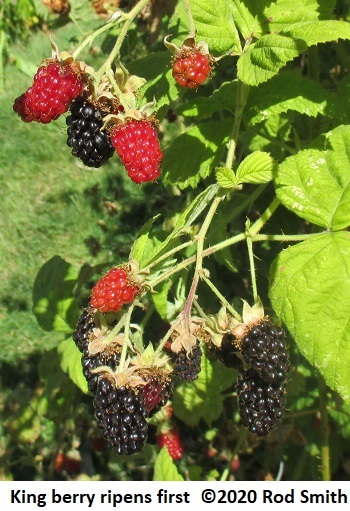 Blackberries, blueberries, currants, gooseberries, grapes, kiwi, raspberries and strawberries are all
Small Fruits. Most do not ripen all at once, so they have to be picked every few days to harvest the
fruit at their peak of flavor. The fruit are evenly colored when they are ripe. However, blackberries
that are shiny black are usually a bit sour. They are the sweetest when they lose some of their shine.
Likewise, gooseberries are often picked when they are green and sour, but they are sweet when they are
yellowish and fully ripe.
Blackberries, blueberries, currants, gooseberries, grapes, kiwi, raspberries and strawberries are all
Small Fruits. Most do not ripen all at once, so they have to be picked every few days to harvest the
fruit at their peak of flavor. The fruit are evenly colored when they are ripe. However, blackberries
that are shiny black are usually a bit sour. They are the sweetest when they lose some of their shine.
Likewise, gooseberries are often picked when they are green and sour, but they are sweet when they are
yellowish and fully ripe.
The newest development in strawberries is the introduction of day-neutral varieties. The time of flowering and fruiting of older varieties of strawberries is controlled by day length. June bearing varieties, such as Hood, will produce flowers and fruit only during the longest days of summer. The time of flowering and fruiting of day-neutral varieties, such as Albion and Tristar, is controlled only by temperature. They start producing flowers and fruit when it warms up in May and they continue to produce flowers and fruit until it cools down in September. If you want a lot of strawberries ripe at once so you can make jam and be done with it, then June bearing is the best choice. If you want a few berries to ripen every day all summer long so you can eat them fresh, then day-neutral is a better choice. There are also a few varieties called everbearing, such as Ozark Beauty, which have a big crop in June and a smaller crop in August.
Blackberries, raspberries and strawberries have a king berry that is on the very end of the fruit stalk. It is always the first to ripen. The secondary and tertiary berries ripen later. It takes a gentle touch to harvest them without smashing them. Bending blackberry fruit sideways will make them break free from the stalk. Raspberries are pulled loose from the core so they are hollow.
 Caneberries produce new canes from the crown each summer called primocanes. The following year they are
called floricanes. Blackberries only produce fruit on floricanes. After harvest, the floricanes are cut
down to make room for the growing primocanes. Blackberries are trailing and are trained on a trellis like
grapes. In late summer, the primocanes are gathered into bundles and trained on a trellis.
Caneberries produce new canes from the crown each summer called primocanes. The following year they are
called floricanes. Blackberries only produce fruit on floricanes. After harvest, the floricanes are cut
down to make room for the growing primocanes. Blackberries are trailing and are trained on a trellis like
grapes. In late summer, the primocanes are gathered into bundles and trained on a trellis.
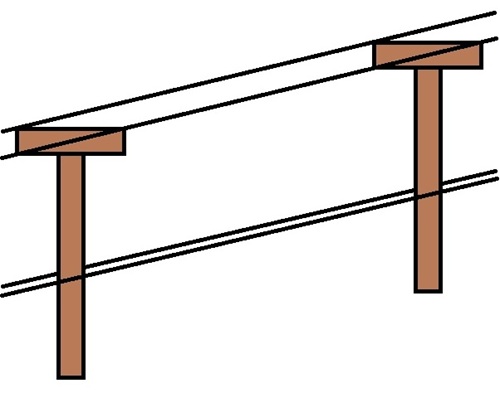
Some varieties of red raspberries only produce fruit on floricanes. They are cut back after harvest like blackberries. Other varieties, called everbearing, produce a crop on the primocanes in late summer as well as a crop on the floricanes in June and July. The flower stalks on primocanes die back after fruiting and are cut off over winter. Raspberries are upright but need to be supported so they do not flop. Primocanes can be tucked between pairs of wires attached to opposite sides of posts or trained between wires on T-shaped posts.
European Grapes, Vitis vinifera, are trained differently than American Grapes, Vitis labrusca. European Grapes are trained vertically to encourage them to grow more vigorously. As the new canes grow, they are tucked between pairs of wires to make them grow upwards. American grapes are trained horizontally to slow down their vigorous growth. Two common training methods are cane pruning and spur pruning. For cane pruning, only the trunk is permanent. Each winter, the old canes are cut back to two buds, and two new canes which have grown from the trunk are trained horizontally. For spur pruning, the trunk and horizontal canes are permanent. Each winter, the new canes are cut back to one or two buds. A starting guide is to leave 35 buds on each grape plant.
Blueberries Two varieties are better for cross-pollination.
Bluecrop: Blue. Midseason.
Bluejay: Blue. Midseason. Mild flavor
Olympia: Blue. Late midseason. Rich flavor.
 Blackberries
Boysenberry: Reddish black.
Marionberry: Black.
Grapes
Himrod: Golden seedless. Early. Crispy sweet.
Lakemont: White seedless. Midseason.
Suffolk Red: Red seedless. Midseason.
Concord: Blue. Best for grape juice and jelly.
Raspberries
Autumn Bliss: Red. Everbearing from July through September. Disease resistant.
Canby: Bright red. Thornless.
Heritage: Dark red. Berries in June and September.
Meeker: Dark red. Late season.
Munger: Black. Mid season.
Strawberries
Hood: Early. Excellent flavor. June bearing.
Sweet Sunrise: Early. Excellent flavor. June bearing.
Totem: Midseason. Very good flavor. June bearing.
Marys Peak: Midseason to late. Excellent flavor. June bearing.
Albion: Good flavor. Day neutral so it bears fruit from June through September.
Seascape: Good flavor. Day neutral so it bears fruit from June through September.
Tri-Star: Excellent flavor but small. Day neutral so it bears fruit from June through September.
Home Page
Site Map
Edible Landscaping
Planting a Vegetable Garden
Herbs for the Kitchen and Landscape
Pest Control
No One Wins an Argument